

Winter Almanac 2025
Intimate Immensity: Cultivating spaciousness within constraint.

!!! CLICK HERE !!! to view a digitized copy of the Winter 2025 Artist’s Almanac.
Want a physical copy? Order one here while supplies last! Want to support The Artist’s Almanac in 2026? Preorder the Spring Edition, or for the whole year! Only $36!
Find further explorations of topics in the almanac in the post below.
This post encourages non-linear reading.
Wander as you would like!

“The world is large, but in us it is as deep as the sea.”
-Rainer Maria Rilke
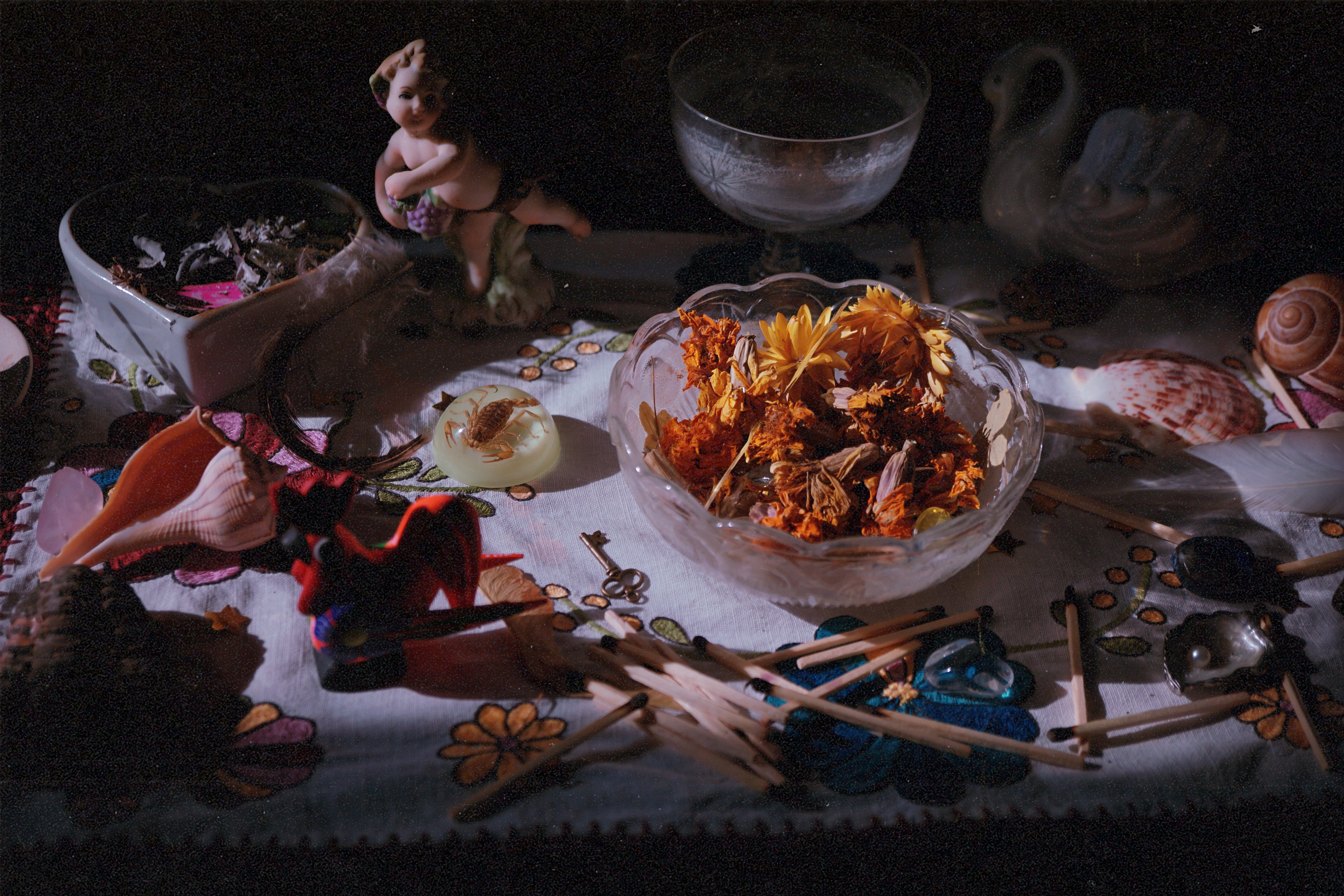
Map of the Almanac
➰ Attention as Artistic Medium
➰ Calendar
➰Shrinking to fit your container
➰ How to take a Digital Vacation!
A Letter From the Author:
Dear Reader,
I hope you will find a companion in The Artist’s Almanac this season.
For any artist, it takes several seasons of creative work to access their true creative spirit. There are no shortcuts in honing your own voice and vision; only the work in front, and years of patiently turning over stinky compost until the first spry green shoots appear.
This winter’s edition of The Artist Almanac is one of my first green shoots. I share it to offer my compost to your creative garden.
The present issue began to constellate last winter, when I picked up The Poetics of Space from my shelf again. It is a book that rambles for several winding chapters about daydreams, shells, corners, and drawers. I re-read the chapter titled “Intimate Immensity,” periodically stopping to watch the winter scene from my window, with snow billowing up in the wake of a passing train.
I’d always been drawn to this book, even though I struggled to make sense of it.
With repetitious readings, and watching the same scene in monochrome every day, the concept of Intimate Immensity began to form concretely in my mind. With practice, I became re-enchanted by the mundane. I became curious about the relationship between myself and the container of my life.
Instead of desiring more, and wishing for bigger, I began to ask better questions.
How do I act within the real life constraints I have? How do I find satisfaction in my creative work, even as a private act? In a culture obsessed with speed and spectacle, how can I find peace working at my own pace?
With these questions in mind, I began to read about artists who lived within tight constraints, and found a way to play within their boundaries.
I read Joseph Cornell’s diary entries, and found a person constrained by his own mind and agoraphobic tendencies. I read about Giorgio Morandi, who, after a mental breakdown induced by his service in World War I, could only paint simple paintings of glass bottles. I read about Arthur Bispo do Rosario, who lived a life in captivity in a sanitorium, making tapestries from hospital uniforms.
With imagination, any container and any humble material becomes immense. With the direction our world is going, it is easy to feel as if the walls are closing in. I hope that this season’s almanac will help readers find spaciousness within whatever constraints they are currently living, and find joy in making with what’s at hand.
I hope that this issue will model a way of being with the world that makes the reader feel at home inside of it, rather in competition with it. I hope that those who pick up this booklet will marvel a little more at smallness.
I compressed these reflections and praxis into a 50 page, 4.25 x 5.5” chapbook.
If you would like to buy a physical copy, please visit my ko-fi shop. If you would like to help sustain the almanac for next season, consider preordering your Spring 2026 edition. You may also preorder for a full year at a discounted rate.
If you have any comments, suggestions, or reflections you’d like to share, please email ThePatchworkPrinciple@proton.me.
Stay warm,
Jeremy
Attention as Artistic Medium
If you find yourself paralyzed over the selection of subject matter, try repetition.
When the scenes we normally rush past are lingered with, they become mysterious and symbolically rich.
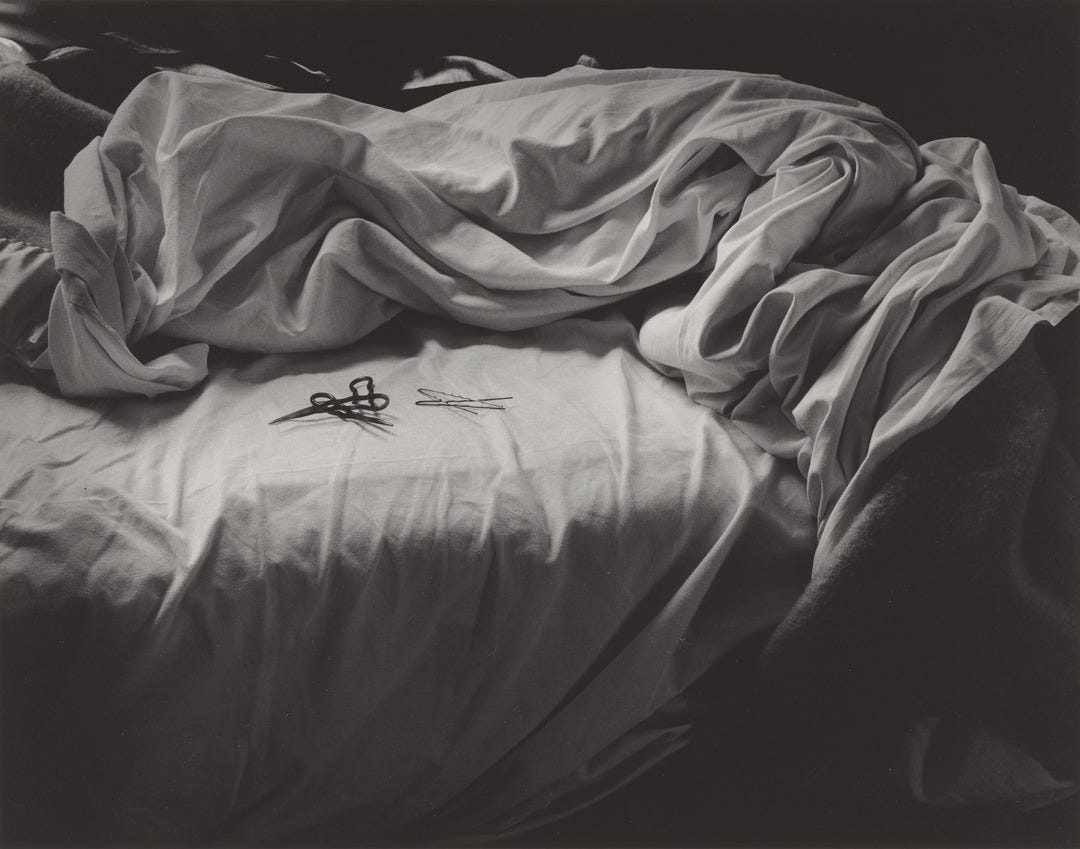
We may use the photograph above to imagine how we might turn our attention into material. The photograph “The Unmade Bed” by Imogen Cunningham was made after Imogen visited her friend Dorthea Lange’s classroom at the San Francisco Art Institute. Lange instructed her students to photograph something that they use every day.
Intrigued by this assignment, Imogen went home and photographed her unmade bed. From this simple image, we may infer that she had a restless night, from the almost sculptural crests and folds of the sheet and blanket. We might imagine that she woke from a nightmare, and relieved to see the sun shine through her window, she took her hair down, resting her pins on her sheet, and felt surprised by a perfect image.
Try This: Using whatever camera you have, capture scenes in black and white. Let the gradations of light be your subject. Return to the scene at different times of day. View these scenes from your every day sculpturally.
CALENDAR
There is a relation between the hours of our life and the centuries of time. As the air I breathe is drawn from the great repositories of nature, as the light on my book is yielded by a star a hundred millions of miles distant, as the poise of my body depends on the equilibrium of centrifugal and centripetal forces, so the hours should be instructed by the ages, and the ages explained by the hours
.—Ralph Waldo Emerson, History
The funny thing about the past, is— it is never past.
We may cross our days off on the calendar, but yesterday, last year, and the past centuries are constantly colliding with the present.
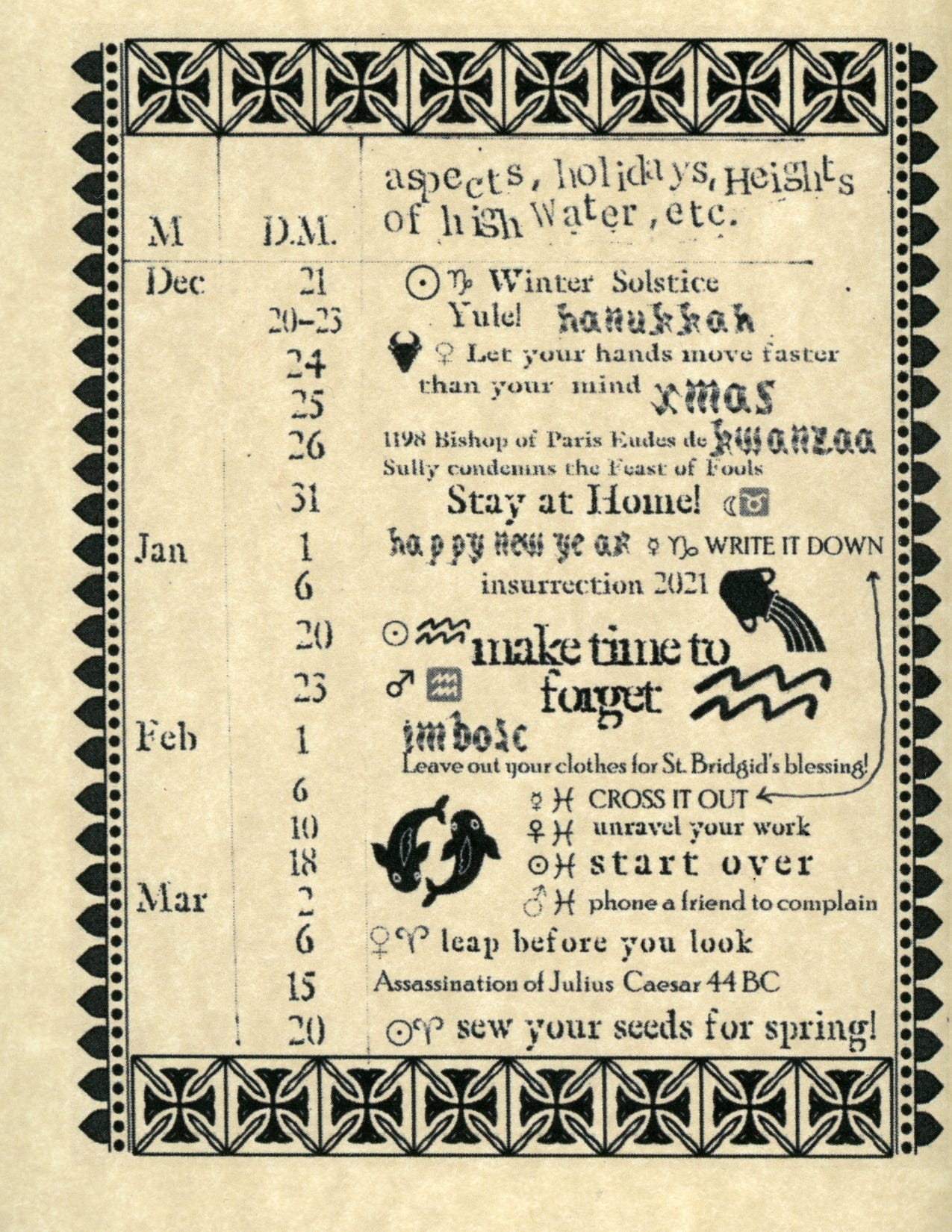
It is troubling to feel yourself inside of time when authorities deny the reality you live in. As a form of protest, I invite you to make your own calendar. Collect feast days, personal anniversaries, forgotten holidays. Create a space within your life to claim authority over your own calendar.
There is a way of living outside of algorithmic time, even though it feels compulsory. We can reclaim our time from the machine in small but powerful ways. This may start by refusing the demand create an optimized calendar, but one that remembers.
Calendars are not only for keeping appointments.
Feast of Fools
Consider adding the Feast of Fools to your calendar January 1st!
We know little about the original medieval tradition, so you and your friends are going to have to establish your own rules. Foolishness is nourishing in any art making practice, so be sure to fit it in when you can. I can’t tell you how to do it.
While compiling the winter calendar, I found it funny that the condemnation of the Feast of Fools and the more recent 2021 insurrection sat so close together. Both are vignettes of history that show a suppressed inversion of power. But, there is a clear difference between a holy fool (foolishness for collective good) and just, a fool (foolishness for individual gain.)
Rejecting foolishness outright is a missed opportunity to grow in humility. We need time on our calendars for the good kinds of foolishness, or else it will manifest unpleasantly.
The Feast of Fools was once a ritual observed on January 1st, and was formally recognized by the liturgy, until its condemnation in 1198. A depiction of the festival you may recognize is the Topsy Turvy scene from Disney’s production of The Hunchback of Notre Dame, when Quasimodo was crowned “king of fools” in a celebration, but it likely did not look like this.
There was a festival outside the church that may have been as rambunctious as you might expect, but inside the church, the Feast of Fools was a reverent, ritual re-enactment god’s birth into the world as a child born to a manager, beside a donkey. The ritual represented a return to a holy, unknowing innocence. It served as an opportunity for the lower ranks of the clergy to climb the rungs of church leadership.
Since the feast was condemned, there are very few written accounts of the particulars of this yearly ritual, but we do know that the ritual involved electing for a day, a clergy of “fools” to subvert power structures within the church for the first day of every year.
When it was condemned, we may assume this was an act of institutional domination, no longer seeing the lowly as authorities of even their own private worship.
Enjoy this scholarly discussion on the role the Feast of Fools played in medieval society in the following video. Throughout, the scholar Max Harris discusses modern-day misconceptions about this forgotten tradition.
Artist Profiles
Joseph Cornell
Recommended Reading: Joseph Cornell’s Theatre of the Mind
Cornell is consistently described by those who met him as inward, childlike, shy, cerebral and eccentric. As a hermit, Cornell held an intense fascination with romance and travel, but allowed himself neither. He chose to stay at home, making his famous assemblage boxes.
Despite securing a place for himself in art history, Joseph Cornell’s life had real constraints. After his affluent family lost their fortune, and the death of his father, he became the caretaker of his elderly mother and his brother Robert, who was disabled with cerebral palsy.
Since his brother could not go to the movies, Joseph Cornell began collecting film reels and editing them to entertain him. His first assemblages were created for the same purpose—to construct dreams for a loved one limited to a small world.
Before he was discovered as an artist, Cornell worked as a fabric salesman, and after losing this job to The Great Depression, a door to door appliance salesman. He spent his free time haunting alleys dime stores for materials that would later be incorporated into his assemblage boxes.
To learn more about Cornell, enjoy this documentary on his life and art.
Also, I highly recommend watching Cornell’s experimental films before bed. They are good for a daydream, too.
Arthur Bispo do Rosário
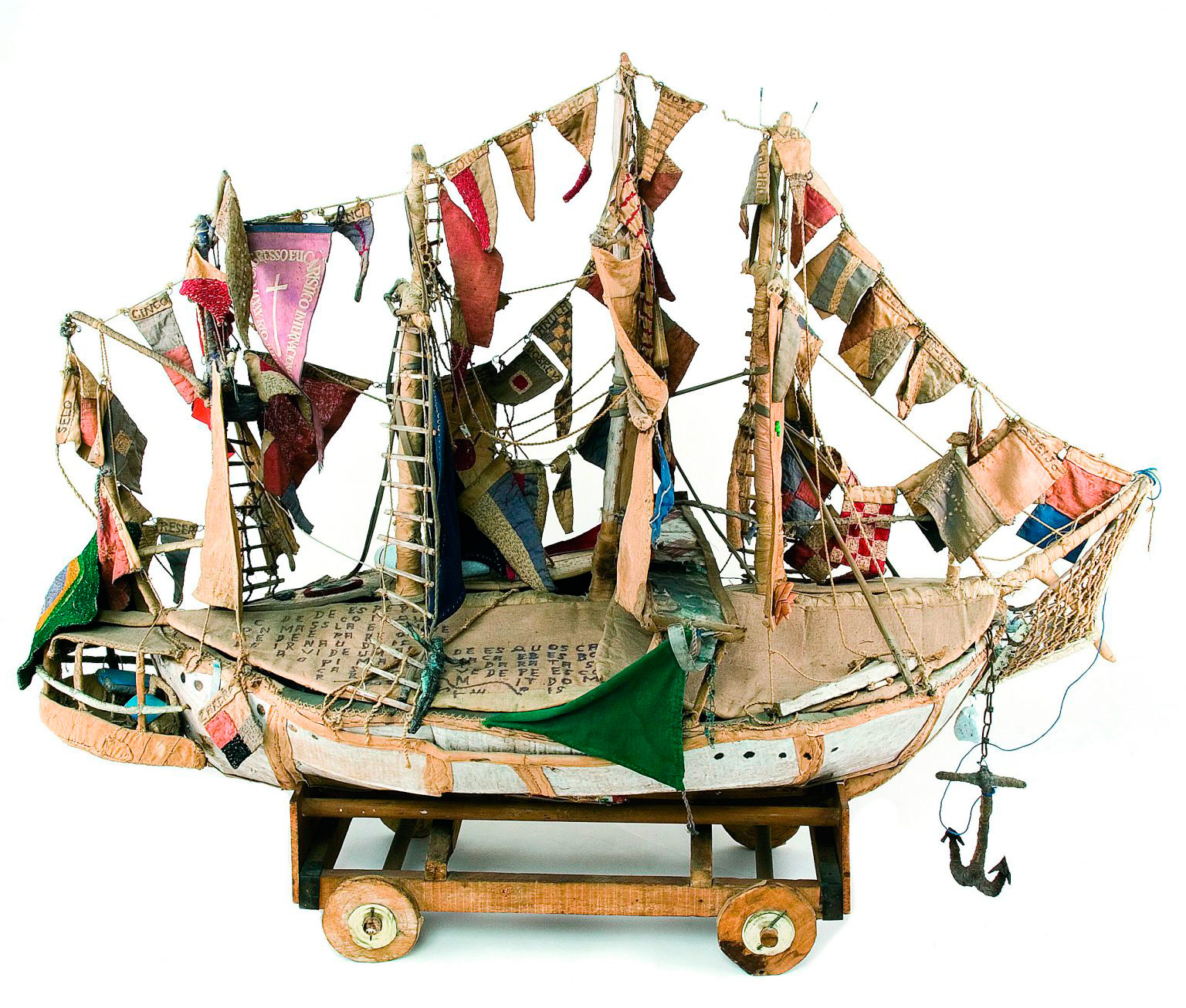
In February I was entranced by this ship, which I came across in an exhibition called Project: a Black Planet at The Art Institute of Chicago. Each flag on the ship was carefully embroidered, every detail of the ship showed a human hand . I knew nothing about the artist when I first came across it, but had to go home immediately to learn more about him.
Rosário made his work completely out of scavenged and bartered for materials with faculty at the institution he was kept in, and with other patients.
If you’re strapped for cash, why not try this approach? Locate your nearest buy nothing group and see what you can find. You may even post that you are an artist in search of a thing. You never know what people have lying around. And in my experience, people in these groups are enthusiastic about giving their things out for creative reuse.
Giorgio Morandi
After fighting in World War I, Morandi must have needed to keep his hands busy to soothe his nerves. He died before post traumatic stress disorder became a diagnosis for veterans, but seemed to have found some space for quiet in painting.
Returning to the same vessels over and over again, Morandi did not worry about narrative in his paintings. Instead, he chose to let his paintings speak purely through light and form.
At home, I have the same arrangement of objects I return to when expression feels too burdensome. Expression can happen without our conscious crafting of a narrative image. We can express simply through the careful attention to light and surface.
Betye Saar
Born in Los Angeles in 1926, Saar grew up with the Watts Towers in the background of her childhood. She cites the towers, constructed with found objects, as the source of her earliest interests in art.
It is easy to see the influence of this structure in her massive body of work, all assembled from the humblest of materials. Like Joseph Cornell, Betye speaks through objects. Unlike Cornell, she is not cerebral. She is explicit about the narratives and histories that objects can tell. At the same time, her work faces America’s violent and racist past unflinchingly, but somehow softens it with humor, reclaiming derogatory narratives for herself.
“Liberation of Aunt Jemima” from 1972 is one of Saar’s most recognizable pieces. Using an antique Aunt Jemima notepad holder, Saar places a hand grenade and a rifle in her hands.
In miniature, Saar collapses history into the domestic scale, and reclaims the narrative of Jim-Crow era imagery.
Recommended reading: BETYE SAAR: Jane H. Carpenter with Betye Saar. The David C Driskell Series of African American Art, volume II.
Julian of Norwich
"To see a world in a grain of sand,
And a heaven in a wild flower;
Hold infinity in the palm of your hand,
And eternity in an hour"
-William Blake
We don’t know the birth name of Julian. When she became an anchoress she gave up her name, choosing permanent enclosure and a contemplative life.
I don’t include Julian in this season’s almanac to convert anyone to Christianity. I have reservations myself. But in putting my personal beliefs to the side, I listened to Julian’s revelations on audiobook, and read about the context she lived within. I could not help but to feel moved by the insight she offers.
Julian says in Revelations of Divine Love that she explicitly asked for her deathbed in prayer, wishing for knowledge of Christ’s suffering. At the age of 30, this wish was granted. On her deathbed, she received a series of “showings” of the crucifixion, which she first relates in a version of this book called “the short text” which is assumed was used in her application to become an anchoress. After enclosing herself in her anchorhold, she spent the rest of her life writing what is called “the long text.”
The extreme sensory deprivation Julian submitted herself to is inconceivable. She confined herself to 144 square feet for life, with only her visions and scripture to reflect upon, and servants to remove her waste and bring her food.
In one famous passage in Revelations, Julian contemplates a hazelnut:
“He shewed me a little thing, the quantity of an hazel-nut, in the palm of my hand; and it was as round as a ball. I looked thereupon with eye of my understanding, and thought: What may this be? And it was answered generally thus: it is all that is made. I marvelled how it might last, for methought it might suddenly have fallen to naught for little[ness]. And I was answered in my understanding: It lasteth, and ever shall [last] for that God loveth it. And so All-thing hath the Being by the love of God.
Further resources:
Listen to Revelations of Divine love for free from Librovox.
T.S. Eliot’s “Little Gidding” references Julian’s words
Reading List
It is good for an artist to read.
Creativity thrives when we make space in our lives to step outside of our every day perspectives, and outside of our own time and place. The best way to practice this change in perspective is through books.
We can’t wonder why we are creatively stagnated while only viewing the world from angle. Instead, we should find a view of the world that is multidimensional. Every book is a contained world, written from a small vantage point.
The following books were curated around the theme of this season. I’ve personally read about half of these, and plan to follow up more in field notes, later this season.
Zen Mind Beginners Mind -Shunryu Suzuki
The Poetics of Space - Gaston Bachelard
Revelations of Divine Love - Julian of Norwich
Mr. Palomar - Italo Calvino
Essays in Idleness -Kenko
At Home: A short history of private life - Bill Bryson
Dust: A history of the small and invisible - Joseph A Amato
Vocabulary Update
At the start of 2025, the President’s administration released a list of words that would be banned from use by federal agencies. This extensive list included words like “injustice,” “bias,” “at risk,” “black” and “LGBTQ.”
At the same time, a linguistic phenomenon began circulating around social media. In reference to Trump, many shared the sentiment that they could not wait until “it” happens.
We still find a way to communicate when the word we are looking for is absent, or not allowed. Almost universally, everyone understood what event “it” stood for. The more he tries and fails to assert domination over language, the more the hunger for “it” to finally happen grows.
Words name reality. An attempt to dominate language is an attempt to dominate meaning. Fortunately, language cannot be dominated. Language evolves under new contexts. Language is a tool for understanding our world, which every speaker of any language is a co-creator in.
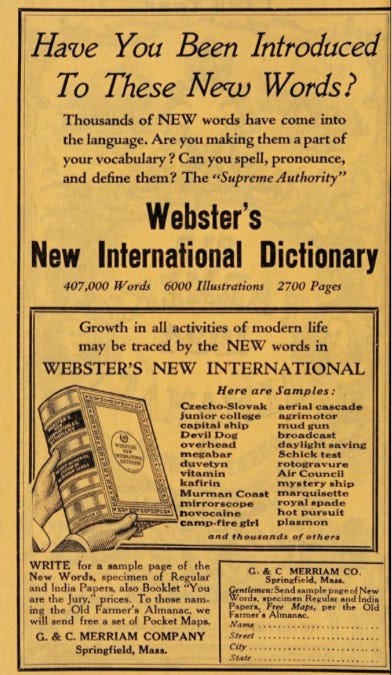
New circumstances create the necessity for new words, and new words do not require institutional recognition. The people will always be in control of language. Have you ever tried making up a word?
Therefore, language is arguably the most important tool in the artist’s arsenal.
An artist who is able to communicate their ideas with clarity is more likely to build a connection with their audience. Unfortunately, by the time the artist’s statement makes it onto the placard next to the piece, all meaning is lost in the elevated, abstracted nonsense. Beyond helping us be understood to others, a closer relationship to private vocabulary enhances one’s literacy of their self.
I have worked in many mediums, but the creative medium I reach for most lately is a pen and a notebook. This would come as a surprise to the younger version of myself. I did well in writing in academic settings, but did not enjoy it. I always knew I had to frame my ideas in a way that would align with what my professor saw as correct.
Returning to the written word as an artist, I can finally work with words as the malleable material they really are. Furthermore, I find that the more that I reach for the lowly words and dust them off, I am able, within the small confines of my home, to restore a personal meaning to them.
You do not have to write in prose or poetry. Language is something everyone uses every day. Private conversations can be intimately immense, and creative, if the speaker actively chooses their own words.
The words I chose for this season included spell, revelation, grace, relic, and enchantment. Words you would hear in church or in a fairytale. I invite you to reflect on these words within your own context.
With your own authority, what do these words mean, specifically to you?
Shrinking to Fit your Container
It does not seem fun to look at the reality of your life and admit that—maybe for the time being—that your wildest dreams are out of reach. Sometimes it is not so bad to scale down in your aspirations and decide to fully inhabit the life you live in right now.
To be clear, I am a big proponent of following an unattainable, unrealistic dreams. I have found that it is good for your character to jump off the ledge and pursue something that you do not yet have the skillset for, or experience in. It is good to take a leap of faith on yourself once in a while. Otherwise, if you hadn’t taken a risk, you’d probably still be where you started.
The major theme running through this season’s almanac is constraints. In creative work, constraints can be word counts or a limited color palette, but constraints are also the life we live inside. The hours we have in a day. The disposable income we do or do not have to purchase materials or take a class.
Recently I have had to get very honest with myself about my container. I often reach outside of my limits of time and money to make the things that I want to make. I have had much smaller containers in the past, and at times, no container at all. The container of my life today is rather cozy, and allows me the peace of mind I needed to bring my creative work to life.
I have picked up some bad habits like paying-in-four for my supplies and a general recklessness in starting new hobbies. Like anyone else I know, I have debts, student loans, a suffering savings account, and doctors appointments I should be going to. I need to, for a time, shrink my expectations of my creative work and attend to life at large.
When we cannot acknowledge our limits, we bring unneeded stress into our creative space, and this hinders us more than it will ever push our work forward.
This season, remind yourself it is ok to let big dreams go for a time and work with what’s at hand. There is a wave of peace that comes when we accept our limits.
Notes on Semantic Drift
Vocabulary should be updated as often as you update your phone’s operating system. Semantics really do drift every day, and our phones themselves accelerate drift, as words and phrases are repeated ad infinitum until they are emptied of all meaning. Even if this drift is subtle, it has major implications on how people make sense of their world
Read the Wikipedia article on semantic change here
Try Out a Digital Vacation!
Your “smart phone” is a threat to your ability to cultivate inner immensity.
Everyone, everywhere is entranced by the immensity of everything but their own lives. While the problems everywhere certainly are connected, the world cannot be fixed at this scale. We have to start with what is nearby. Yes, global problems are interconnected, but it is all held in place by a global atrophy of attention.
A “digital vacation” is suggested in the almanac’s winter checklist, so I thought I would give some ideas about how to go about planning one, as well as some insights into the benefits of limiting my engagement with tech. I want to avoid the idea that we can be saved from screen time entirely. In many ways, we have to have them. Still, we should seek ways to negotiate.
Everyone I know in every age group struggles with screen addiction to some extent. When I bring my flip phone out at a party, it instantly sparks a conversation that follows a predictable arc.
It begins with an interest in my phone, how I live with it in my daily life, and i vent about the oppressiveness of technology in our lives. My conversation partner shares shame about doom scrolling and bed rotting, and the barrage of poor quality, dementia inducing content they are force-fed every day. But, giving up Spotify and Uber would be too much of a sacrifice.
At a certain point, I had to tell myself I could choose my phone or choose my life. I could not pretend I didn’t know why I was miserable. I have happily lived with a flip phone for the past 2 years.
As a millennial, I have had one for most of my life and became acquainted with the idea that everything in the world should be quick, easy, convenient, and available to me at all times. This is the oppressor's mindset, and it’s best we disengage from it.
The more that I played with living outside of this belief system, the more autonomy I feel over the kinds of ideas and content I consume. Most of what we see on our phones is completely nonconsensual. It has been overwhelmingly positive to cut out the fat in my media consumption.
This is not to say that this lifestyle decision is easy, or that it’s fixed all of my problems. I still become hypnotized by my laptop screen, but I have maintained a healthier boundary with real life and the cyber world.
I can say with confidence that not having a “smart” phone has helped me develop a deeper presence and satisfaction with life—even while requesting a physical menu at a restaurant becomes more difficult every day.
Something about the infinite supply of brain rot truly is enchanting, but not in the way I want to choose to be enchanted.
Try a digital vacation if you find yourself with some time off, outside of your usual routine this winter. This is something my partner and I have begun to do periodically.
Collect physical media. My partner and I peruse our library’s collection online, and order holds for whatever we want. Curate the movies you want to watch, the music you want to listen to, and the books you want to read. Try to step outside of the algorithm and make selections that you are specifically drawn to. In time, selecting your own media will bring you closer to your own unique tastes and interests, and you will see this reflected in your art making.
Consider a burner to start. This phone is what I use. It is low investment, and you can even download music to it to listen to MP3s, and it even has google maps. I hate amazon, but I offer this link because it’s accessibly priced and low commitment.
Ask a friend to babysit your tech while on vacation. I recommend 2 weeks to start: the first week for agonizing boredom, the second to luxuriate in it.
If you’re single or live alone, identify a buddy to take a digital vacay with. It’s best to have someone to lean on while you cut the world out for a while.
Write letters and journal! I guarantee you will feel more connected to your friends with slower communication methods.
When you return to the internet after your time away, you may notice that the hot button talking points that once got under your skin are mostly irrelevant to your every day life. You may see that those around you, buried in their phones, are giving up something essential of their humanity. The unmediated experience of life, even when it is gruelingly boring and ugly, is not something you want to give up. I promise you this.
Even if this is not a permanent lifestyle change, I am positive that this time away may help you draw a clearer boundary between what is real and salient, versus what is fabricated and distracting. Whatever you do, it’s important to be deliberate about what you consume, and what you consent to giving your attention to.
What you see on your phone cannot be relied upon as a valid document of reality. Don’t let yourself be alienated by the surveillance device in your pocket. Don’t let this be the primary lens you view your life through. The world close to you is very much real, alive, and it needs your presence, if you really wish to change it.
Dumb Phone Resources:
Tremp is a service that allows you to order rideshare over SMS
Taxis still exist! Save local taxi numbers in your dumb phone.
Get free maps from AAA.
Use google voice or a zoom phone if you still want the option to send longer text messages
Librovox has plenty of free audiobooks
Classifieds
Have something you’re selling or seeking? Post it in the almanac! Shoot me a DM or email me at thepatchworkprinciple@proton.me and I’ll add you to the list.
Local resources in Chicago:
The Joy Lab! - Where The Artist’s Almanac was printed! For an hourly rate, rent time at the Joy Lab to use a wide variety of tools to bring your projects to life!
Sailor Seguine Hall - Woodworker and Photographer open to commissioned projects!
Ur Mom Records! - Custom 7 inch Records for musicians. 6 minutes on each side. Local pick up or shipping available.
Englewood Arts Collective - Looking to give this season? Consider supporting Englewood Arts Collective! A local arts focused organization serving the historically divested Greater Englewood area.
The Chicago Toilet Altar: A project documenting the phenomenon of altars placed on the backs of Chicago Toilets. Email Jun art theonetrueCTA@gmail.com to talk about your toilet art.
Emily Chloe Quinn Ensemble - An original Baroque-Pop group in Chicago, featuring a unique blend of vocals and instruments, bringing classic chamber style into the present.
Everywhere else in the world!
The Groke - A Literary magazine now accepting submissions for the winter.
Tarot for Creativity - Chelsey Pippin Mizzi offers readings, resources and virtual events for anyone curious about how the tarot can provide guidance in their lives and creative work.
Those Lights at Night - A Novella by Adrianna Nine , is a story of community, grief, and anticapitalistic sentiment set against a UFO-laden desert backdrop.
Mars in Retrograde -From Boston author James Worth comes his debut novel, Mars in Retrograde, following a group of problematic misfits on the search for free will and sanctuary at the approaching end of the world, which may or may not be a metaphor.
Emily Stroud- Original paintings and prints for sale!
CansaFis Foote - For free fun, fotos, and other fabulous “F” words, please visit cansafis.com!
This is amazing!!!!!
…turned out amazing…can’t wait to see the physical thing…