

The Scrap Drawer: Please Forget My Name!
Thoughts on artistic identity from Borges, Quasimodo, Claude Cahun, Vivian Maier, Peewee Herman, and The Burning Bush.

The Scrap Drawer is a monthly quilted essay assembled from the things I keep: memories, photographs, a page of a book I've tabbed, or a scene from a movie.
The form mirrors the shape of each month, how my life looks, and where my attention falls. Some of these quilts might be intricately pieced, or a whole cloth.
This is a monthly practice of making sense of a fractured world by honoring each scrap, finding their places within the whole.
Dear Someone,
On many days I would rather be no one.
I watch the pollinators working in my garden with envy. Even if it was my hand that scattered the seed, there is not all that much time to enjoy the blooms.
It is not that I wish for death. I wish for the unselfconscious existence the bees enjoy; one that is rhythmic and sensorial, and totally free of the need to sign my name to a “Terms of Agreement“ ever again.
Lately I have felt a growing resentment towards my own name.
My name is at once a burden and something I hold dear. It is a distraction from the hum of the cicadas on my afternoon walks. It is also the first word I learned to spell, the name my mother called me in for dinner, and the excited arrangement of syllables I hear when I see a friend after a long time away.
There is bliss in having a name, and also the tragedy of losing it to an epitaph etched in stone. This is the path we must all trace, learning to love our names and then let them go.
If you read my letters often, you have followed me on this path of learning to love my own name. Now that I have learned to love it, I must learn to give it up.
As someone who wishes to live as an artist in our time, amid mass surveillance and compulsory self-surveillance, I have come to see the burdens of a name outweigh the advantages.
To process and reflect the times as an artist should, names must be forgotten. The selling of the name cannot come before the selling of the art. I have realized in retrospect that our correspondence would be much more effective if both parties remained anonymous, free to share our findings without a mask.
I have shared my name with you before, but I kindly ask that you forget it. I would like to proceed in my work without the need to make something of my name. I only want to do my work.
The scraps I have arranged below orbit around this central question of names, and how different artists have dealt with them throughout time.

1. Borges on a Ninth Century Poem
I stumbled upon this book by Borges earlier this year. Through its explorations on language and early literature, It has helped me to excavate a deeper self in my writing—one freer of name and identity.
On page 16, Borges cites a Norse poem of the 9th Century, arguing that it is best for a poet to remain nameless. The poem goes:
It snowed from the north;
rime bound the fields;
hail fell on earth,
the coldest of seeds.
Borges provides the context around this short poem. In the 9th century, when people thought in terms of mythology, this verse would have been an entirely new way to speak
Rather than speaking through myth or allegory, the author of this poem was simply recording what they saw.
Modern writers do not often allow themselves this way of seeing, as if they were the first to see it. When we record our surroundings in this way, it trains us to defamiliarize our relationship to the world, inhabiting this unnamed state of being.
2. Quasimodo
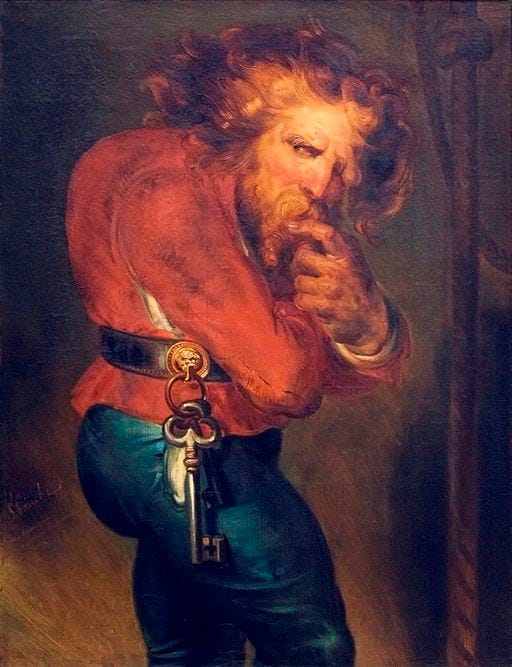
In 1828, Victor Hugo took on a commission to write a novel titled Notre-Dame de Paris. He conceived the book’s protagonist, Quasimodo, when he saw the word Anankh (Greek for “fate”) carved into the stone wall of a bell tower in the Notre Dame.
Hugo imagined a nameless bell-ringer hidden from the world in a cathedral, a character that we have all come to know as The Hunchback of Notre Dame. He named him Quasimodo, a name that translates from Latin to “as if newborn babes.”
Hugo’s fictionalized character who arrived on the steps of the cathedral as a disfigured infant has become an archetype for persons denied happiness and othered by society for their appearance. There is evidence that this character was modeled after a real person, a stone carver working at the cathedral only remembered as “Le Bossu” (French for “Hunchback.”)
Quasimodo, and his possible muse “Le Bossu,” entice the reader to imagine who is hidden in the shadows of history, and what of life we miss without perspective of those half born to the world.
3. Claude Cahun
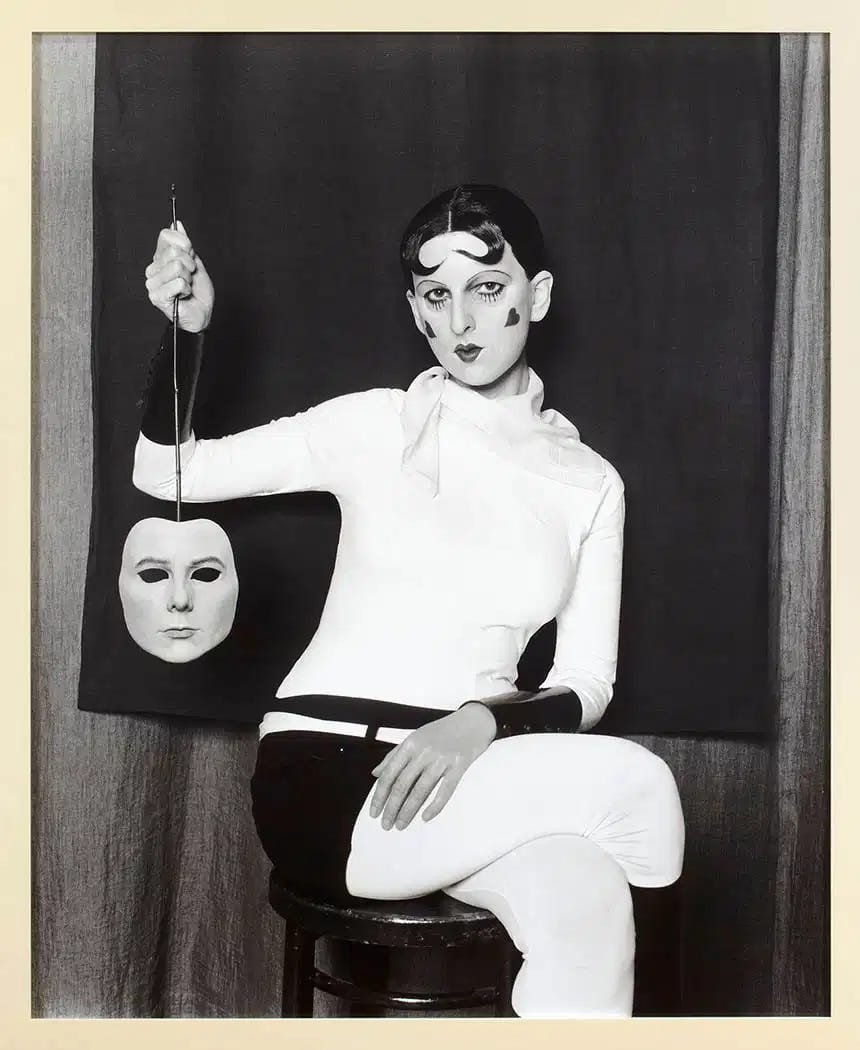
Born in 1894 as Lucy Renee Mathilde Schwob, and nicknamed “Little Pig” by her mother, Claude Cahun had a complicated relationship to selfhood.
Through writing and self portraiture, Cahun sloughed off the assigned roles and expectation of Victorian womanhood. She depicted herself in many of her photographs with a shaved head and eyebrows, renouncing all ideals of beauty and femininity in pursuit of a truer image of herself.
Cahun’s self portraits remained in obscurity until the 1990s. Their discovery was significant to artists and writers concerned with feminism and modern discussions of identity. These portraits were a private creative act, between Claude and her partner, taken amidst the rise of Nazism.
During her life, Claude and her partner committed themselves to writing on topics of feminism and negating fascism. The pair anonymously self published literature imagining nameless German soldiers, encouraging them to reconnect to their humanity and abandon the Nazi project.
4. Vivian Maier
In 2009, an unknown photographer died, leaving behind 150,000 photographic negatives in a storage unit. A lifetime of prolific photographic work meticulously archived, without much evidence of intent to exhibit it.
Vivian was discovered by John Maloof, a man who bid on a collection of her negatives in an auction without provenance. After discovering an exceptional collection of photographs, Maloof followed a trail of breadcrumbs, uncovering the life of a nanny documenting the world in secret.
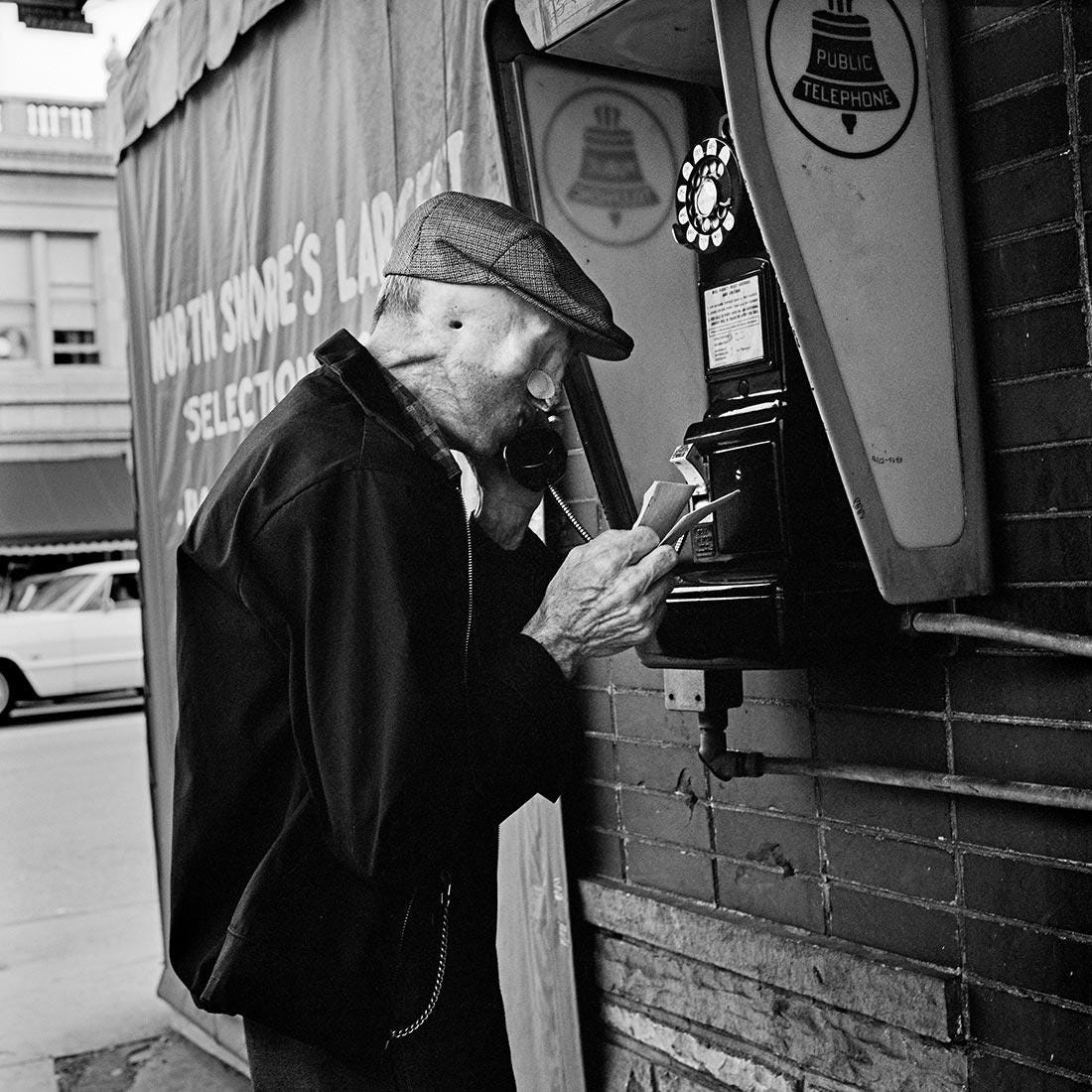
Vivian was evasive about giving her name. She often changed the spelling, and introduced herself to different people with slight variations of names and nicknames—Viv, Vivian, Ms. Maier. Her origins are also elusive. She claimed to be French, but her birth is documented in New York state.
She moved through the world invisibly with a camera, documenting New York and Chicago, and her world travels. She had a truly democratic eye, choosing subjects at every rung of the social ladder.
Many of her subjects were homeless, depicted in vulnerable positions that would have created some ethical muddiness if she had shared their photos within her lifetime. With the photographer and subject both nameless, Vivian gives us a clearer vision of the world that could not have been given if she had the goal of being known.
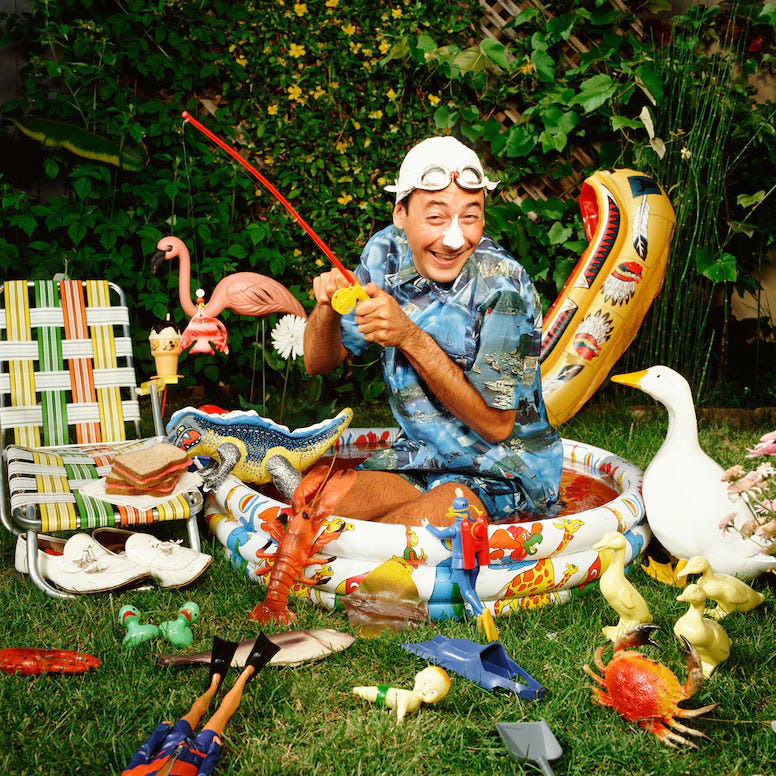
5. Peewee Herman
Paul Reubens built a career as the zany, over-the-top character the world knows as Peewee Herman. Peewee lived in his playhouse in a looping timeline. Every day was the same: a word of the day, a cartoon, and connect the dots. The time and location the playhouse exists in remains ambiguous.
Peewee was but one character in a cast. Other names include Cowboy Curtis, Miss Yvonne, and the mail-lady, Reba. Everybody had a name- Mr. Window, Mr. Kite, The Flowers, but no one’s name in this universe more important than the other.
Paul Reubens appeared to the world as Peewee on red carpets and in interviews, until he was forced to speak to the world as Paul after he was arrested at a pornographic theatre in 1991. This led to a public trial that scoured his private collection of adult entertainment, slandering his public image.
At the end of the documentary, “Peewee as Himself” we hear Paul Reubens unmasked, on his deathbed, lamenting being labeled a pariah. He had only wanted to give the world joy through his work, but once his legal name was attached to scandal, neither Paul nor Pee-wee could escape it.
6. Britney Spears
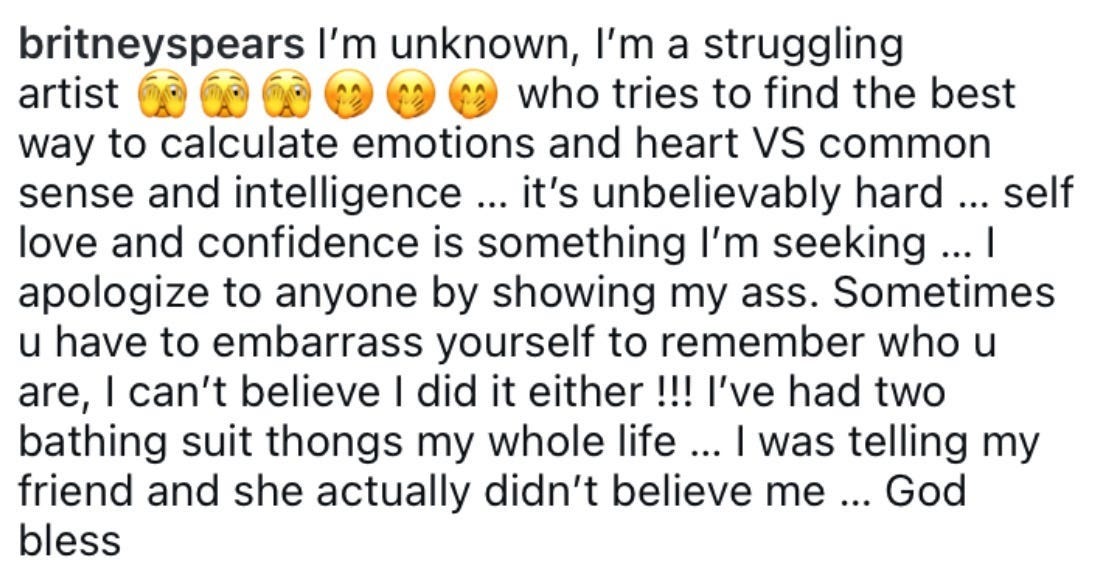
I have known the name Britney Spears all of my life. I first heard of her through a “hit clip” playing 5 seconds of her song “Baby One More Time” on the playground. Her name is known to all, but her true personhood obscured by limelight.
Her music, the most private details of her life, her relationships, and her conservatorship are known to the world. But her presence online is defiant against everything we think we know of her.
In this Instagram caption, we see one of the worlds most famous pop stars asserting herself as an unknown, struggling artist. Someone who, beneath it all, still struggles with self love and confidence, but keeps reaching for it. I think this is art in its purest form.
7. Ya Hey - Vampire Weekend
When speaking to Moses through the burning bush, god themself would not reveal a name—only “I am that I am.”
The Vampire Weekend song “Ya Hey” explores this theological conundrum: The ultimate creator, responsible for all creation and destruction, will not confine themselves to a single name. Even to an atheist, this is a thought experiment worth examining for ourselves.
What does this mean for the rest of us who are forced to live here on earth? We require a name to live here..to be known and loved. But we forget our names so that we can know others.
I am searching for a connection to my own name in this digitally mediated world that feels more true and honest. I want to move forward with my work without so much concern for it.
If I want my work to be of any worth to anyone else, I will have to surrender it, or, find a way to relate to it differently.
Perhaps I will try on a new name all together.
Until next time,
…?
Your point about wanting to separate your work from your name is one of the reasons I love myths and fables so much. They have not one but tens of thousands of authors. It's impossible to go back and trace the names that taught and reared each story, but I also find that when I get it right and share such a story properly, whatever is happening is not at all about me. No one's listening to me, they're listening to the thing that's been let out in the room around them. It's a relief not to have to claim it as my own but just help it stretch its legs in the best way I can.
Such a rich and delicious collection of names-that-point-to-mysteries, have a feeling it'll linger as food for thought