

Field Notes: Time for Forgetting
Notes on creative practice as a ritual of forgetting

These are Field Notes: real-time reflections prompted by The Artist’s Almanac as I make throughout the season.
These are my notes in the margins, where I scribble out my own words, reaching for what lies beneath.
Read the current edition of The Artist’s Almanac here.
Before jumping into today’s field notes I’d like for you to watch this short video of Joseph Campbell discussing his concept of a “Sacred Place.”
Throughout todays notes, I’ll be sharing about my sacred place and how it fuels my creative practice. I hope my reflections make space for you to reflect on your own sacred place.
If you aren’t familiar with the late Joseph Campbell, he is an important writer and scholar of mythology. He believed mythology has important functions in the progression of the human race, and provided a means for us to understand our position in the order of the things. Even if myths were only stories, they have shaped consciousness, and therefore human progression. Today we find ourselves in a story that does not work.
The more the world becomes connected by constant and instantaneous communications, the less we seem to agree about the order of things. By now there are many myths to choose from—so many that choosing what to believe in is overwhelming. Just remember, the myths that are easiest to accept are never the right ones.
This is work we all must do in our own sacred places. If you are lucky to have one, use it.
Map of Field Notes
Feel free to jump around and find the notes that you need!
Calendar—Current atmospheric conditions—aspects, current events, and heights of high water.
Loss of Memory—a Chinese folktale speaking to the timeless problem of memory and forgetting
Marginalia—An extended conversation between the ideals of the almanac and the constraints of real life. An attempt to write myself out of thought spirals and into making.
Praxis— Clear, concrete actions for the hands to take.
Resources—further readings and work I’ve been inspired by recently
Calendar
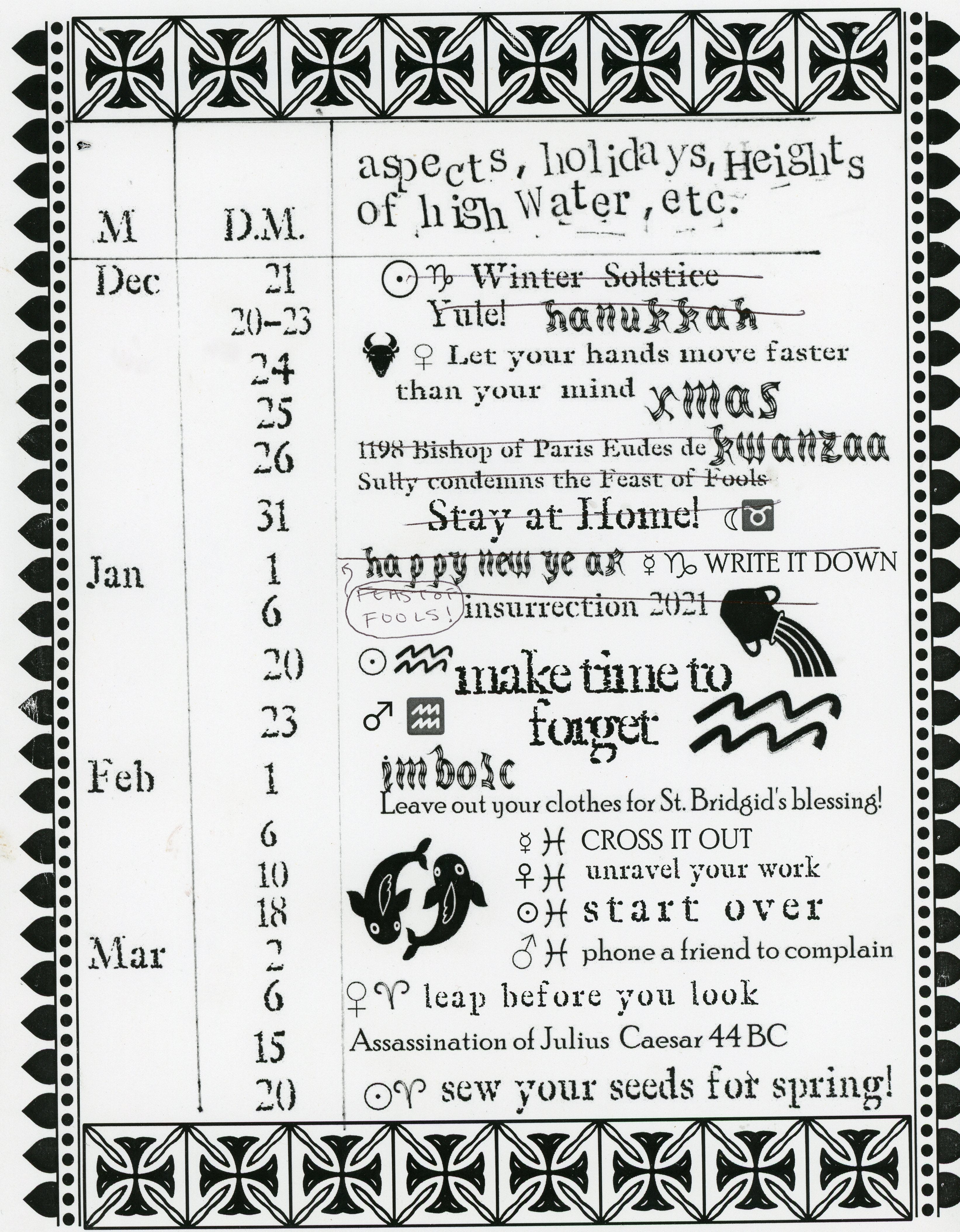

January 24th, 2026: Sun, Mercury, Venus, and Mars align under the sign of Aquarius, the water carrier.
Where I live, water crystalizes on the sidewalk when the sun is in Aquarius.
In this season, we Chicagoans curse our neighbors as we slip and fall in front of their houses with unsalted, unplowed sidewalks. Movement becomes limited, aside from absolutely necessary trips to work and for groceries.
In warmer months the water carrier’s task is easy. In January, the job requires an ice pick, and boots with good traction.
I am trying to take advantage of this season of Intimate Immensity, taking time away from the internet while I work on my inner space. Among the many other items on my to do list, I must make time to forget.
But earlier this month, a woman named Renee Good was murdered in cold blood a few states away by federally funded ICE officers, in the same uniforms seen terrorizing my city.
Seeing the video of Renee re-shared endlessly, distance collapses. I fear seeing blood on the snow on my street. I become frozen, refreshing for updates. I need an ice pick.
I can’t get anything I want to do done if my attention is given to everything.
Anything I can do seems trivial. It is a mess inside my mind. I want to clear some space in there in order to be more present to what is here and nearby. Nearby is where I can be of most service.
These are the conditions of the season. I wish I had done more so far. I’m trying to just show up as I am. No matter how many times my sacred space is invaded, I rebuild it, fortify it, and try again.
This all may sound like doom and gloom, but there have been spare moments of bliss in oblivion. I just have to keep moving my hands in pace with my mind.
[click here for some actions I’m taking to get out of my head]
Loss of Memory - a Chinese Folk Tale
I came across this folktale in ‘Chinese Fairytales & Fantasies,’ translated and edited by Moss Roberts from The Pantheon Fairytale and Folklore Library. I thought it too perfect to not include in today’s notes.
Hua Tzu of the state of Sung suffered a loss of memory in his middle years.
Whatever he took in the morning was forgotten by evening. Whatever he gave in the evening was forgotten by morning. On the road he would forget to move ahead. Indoors he would forget to sit down. Here and now, he has forgotten then; later he will not remember the here and now.
His whole household was plunged into confusion by his ailment. Finally he sought the help of an astrologer, but divination provided no answer. He sought the help of a medium, but prayer could not control the problem. He visited a physician, but treatment brought him no relief.
In the state of Lu there was a Confucian scholar who claimed that he could cure the disease, and Hua Tzu’s wife paid him half their estate to do it. “No sign or omen,” said the Confucian, “can solve this. No prayer can preserve him. No medicine will work. I must try to transform his mind and alter his thinking; then there may be hope.”
The scholar stripped Hua Tzu, and the naked man demanded clothes. The scholar starved Hua Tzu, and he demanded food. He locked Hua Tzu in a dark room, and he demanded light.
The delighted Confucian said to Hua Tzu’s son, “This illness can be cured. But my remedy is a secret handed down for generations, a secret that has never been revealed to anyone outside of our family. I must ask you to dismiss all your father’s attendants so that he can live alone with me for seven days.” The son agreed.
No one knows what methods the scholar used, but Hua Tzu’s ailment of many years cleared up. When Hua Tzu realized that he was cured, he went into a tremendous rage. He chastised his wife, punished his son, and drove off the Confucian with his weapons. People seized Hua Tzu and asked him why he did this.
”In my forgetfulness I was a free man, unaware if heaven and earth existed or not,” said Hua Tzu. “But now I remember all that has passed, all that remains or has perished, all that was gained or lost, all that brought me sorrow or joy, all that was loved or hated—the ten thousand vexations of my decades of life. And I fear that these same things will disturb my mind no less in times to come. Where shall I find another moment’s oblivion?”
—Lieh Tzu
Marginalia
Good advice is hard to take.
If I may say so as the writer, The Artist’s Almanac is full of great advice. But is it possible to apply the kind of slow attentiveness this season of Intimate Immensity prescribes to these modern times of compulsory connectedness?
Am I perpetuating the kind of impractical creative advice-giving I hope to avoid?
This is why I am sharing my notes. I want to show as clearly as I can how I apply the ideas from the almanac to my creative work and my life, and where they fall short. I want to show all of the friction, frustration, and yearning that I would usually clean up before hitting the button that says “send to everyone now.”
While the almanac is idealistic, Field Notes will be a space to show my ideals falling short in reality.
Even if ideals break under the pressure of real life, ideals are still worth having and returning to. In creative work as in life, there are constant negotiations we must make between reality and ideal. The art and life we wish for may not be entirely possible as we’d imagination, but it is still worth aligning yourself with your own will.
This season is all about recalibrating my attention towards the small and nearby. I think that winter is a season to slow production, to return to your innermost self and reflect on what you intended during your sowing, cultivation and harvesting. It is likely that in all of the commotion of the growing seasons that you ended up somewhere entirely unexpected.
Sometimes this unexpected arrival is exciting in creative life. Other times, we are swayed by our needs to survive, and adapt to economic forces. In either case, there must be a season when we lay down our tools to come back to center.
Reflecting back to the video of Joseph Campbell I shared at the start of today’s notes, it is so easy to loose track of your original intentions. It’s easy to confuse someone else’s aspirations with you own.
When I reflect on my intentions of starting this newsletter project nearly 3 years ago, I wrote in my notebooks that I wanted to share the benefits of the therapeutic art practice I was developing with my art therapist.
I began to write and share openly about personal experiences with housing instability, experiences I was working to develop a new narrative for with my therapist.
There are some insights I’ve gained from this work that I hope to share, but I think they’re still developing. I’m still at the beginning, and I have to work on not rushing towards an end. I don’t have any conclusions I can offer, only marginalia.
In hindsight, I can see that self exposure through lengthy lyrical essays did not produce the effect I’d hoped to have for my audience, but it was what I had to offer in those seasons. I had not completed this process myself. I became stuck in a years long loop of writing to justify my art making and experience. But this is just apart of the journey.
Coming into this next season, I’m worried less about being legible. I think I’m still working on becoming legible to myself.
Praxis
These are some tangible actions I’m taking towards getting out of my head and into making.
1. Make Art No one Sees
To become the kind of person who can dance like no one is watching, you have to stop surveilling yourself and just do it.
I want to be the kind of artist who makes like no one is watching. If all of the art I make is made with the potential of an audience, I fear I may never find my groove. I’m in need of better boundaries.
I have developed a bad habit of putting most things I make into this newsletter. This opportunity to share my art with an audience has been exciting, and given me some incentive to make. But this has become problematic, because it can dilute my work when I am thinking too much about the audience. If I am being honest, I have dealt with a lot of self consciousness in the process.
The point of the dance is not to become a spectacle. Eyes are on you are certainly a plus, but you go out dancing because its fun and its a great way to make friends. Whether the dancer is dancing with panache or flailing their arms frantically, they are adding a spontaneous, creative energy into the room, and that is the goal.
It’s just me in my house, alone, making art.
Why does it always feel like someone is watching?
When I reflect on what I really want from my work, I really don’t care about becoming a spectacle. I want to be part of something. I want to treat it the same as when I used to frequent dance floors.
I can show up, offer my energy, and go home. That is enough. Not everyone has to know my name. It is enough to just make an offering to the party.
2. Reading About Folk Art and Folklore
I am a folk artist. The more that I learn about folk art traditions throughout history, the more I return to my core sense of purpose in my making. I do it because I am just that kind of creature. I need no other reason! Art is an activity for normal people like me.
I think if you can align yourself with some kind of folk tradition, it will help you escape this identity trap so many present day artists find themselves stuck in. Art making can just become a way of being in the world rather than a career. The more that I embrace folk, the more grounded I feel.
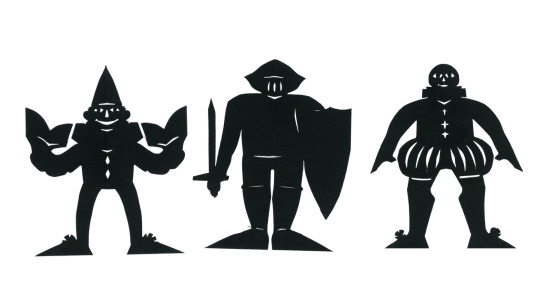
I’m connecting to this tradition by practicing paper cutting. I got a stack of black paper and I cut. I’m finding I work best in complete silence, just listening to the sounds of the blades cutting paper. I’ve noticed the less expectation I have, the more fun I have because I’m surprised by what I come up with.
For reading, I’m bouncing around between some books I checked out on the art of paper cutting, my book on Chinese folklore (with an excerpt included earlier in this post,) and the classic Brother’s Grimm collection of fairytales.
Folktales always surprise me with the insights they offer me, and how the human dilemma remains the same.
Folktales and folk art are the literary and artistic contribution of ordinary people. They remind us how ordinary people have always played a role in shaping culture and our stories.
3. Digital Vacation
I took 2 weeks off work recently, ridding my house of internet capable devices to take a digital vacation. While taking time away from work, I left my laptop and tablet locked at my office. Time away from the internet is bliss, but bliss may quickly become boring when you are used to so much constant stimulation.
A few days in, my partner and I fished a retired Chromebook from the back of our closet to watch an episode of Vanderpump Rules. In a strange way, If I’m not watching Bravo, I don’t know what’s going on. Without it, I am not versed in the mythology of our time.
The ancient Greeks had cupid and Psyche, we have Jax Taylor and Stassi Schroeder. I don’t like it, but it is what it is.
The banal and horrific enter through this tiny screen. The internet is a terrible place, but a wonderful place. It shows me everything I love and hate all at once. I cannot live with it or without it.
There is much discourse lately about the analog “trend,” and how it is a privilege to unplug. I’ve seen many sentiments that it is unrealistic, and even that desiring a life with limited internet access is nostalgic.
Nostalgia is not the dirty word you may think it is. Sometimes it is a valid sensation. Another word for it may be regret.. Sometimes the future that is built is clearly worse than the past. It seems that although many agree that the current conditions of life are unlivable, there is something in human nature that just can’t help itself from opening Pandora’s Box.
No matter how many times I put it down and come back, I’m glad I am atleast negotiating with it. I think that even if people are imperfect in their attempts to go offline, time offline is always time well spent.
I hate it here. I’ll see you tomorrow.
Further Resources:
How to Share Reality: A Pocket Guide for Humans Caught in the Algorithm
This zine by Zak Foster offers some great insights on how we might think about being more gracious in our human connection in algorithmic cacophony.
A Year of Personal Creativity by Chelsey Pippin Mizzi
I found myself nodding along throughout
I also enjoyed finding the following video on Youtube from a fellow Chicago based artist!
I love how intentional you are about your intake, I don't mind being on the internet a lot as long as it's intentional and for me it's not and it's toxic. I think that's what we're all really falling into. I need to start doing art again.
…i hate it here, i’ll see you tomorrow, 2.5 stars, the internet on yelp, the sound of a coyotoe in pain, enjoyed the video, most of all the hopeful idea that for some who have lived everywhere is a sacred place, and with more legibility, or perhaps just time, that may someday be true, or at least i hold that hope…