

Field Notes: Keeping the Hands in Pace with the Mind
Reflections on a year of rumination and stitching, and merging life, art, and professional work.

These are Field Notes: real-time reflections prompted by The Artist’s Almanac as I make throughout the season.
These are my notes in the margins, where I scribble out my own words, reaching for what lies beneath.
Read the current edition of The Artist’s Almanac here.
Keeping the Hands in Pace with the Mind
February 4 2026 12:30pm
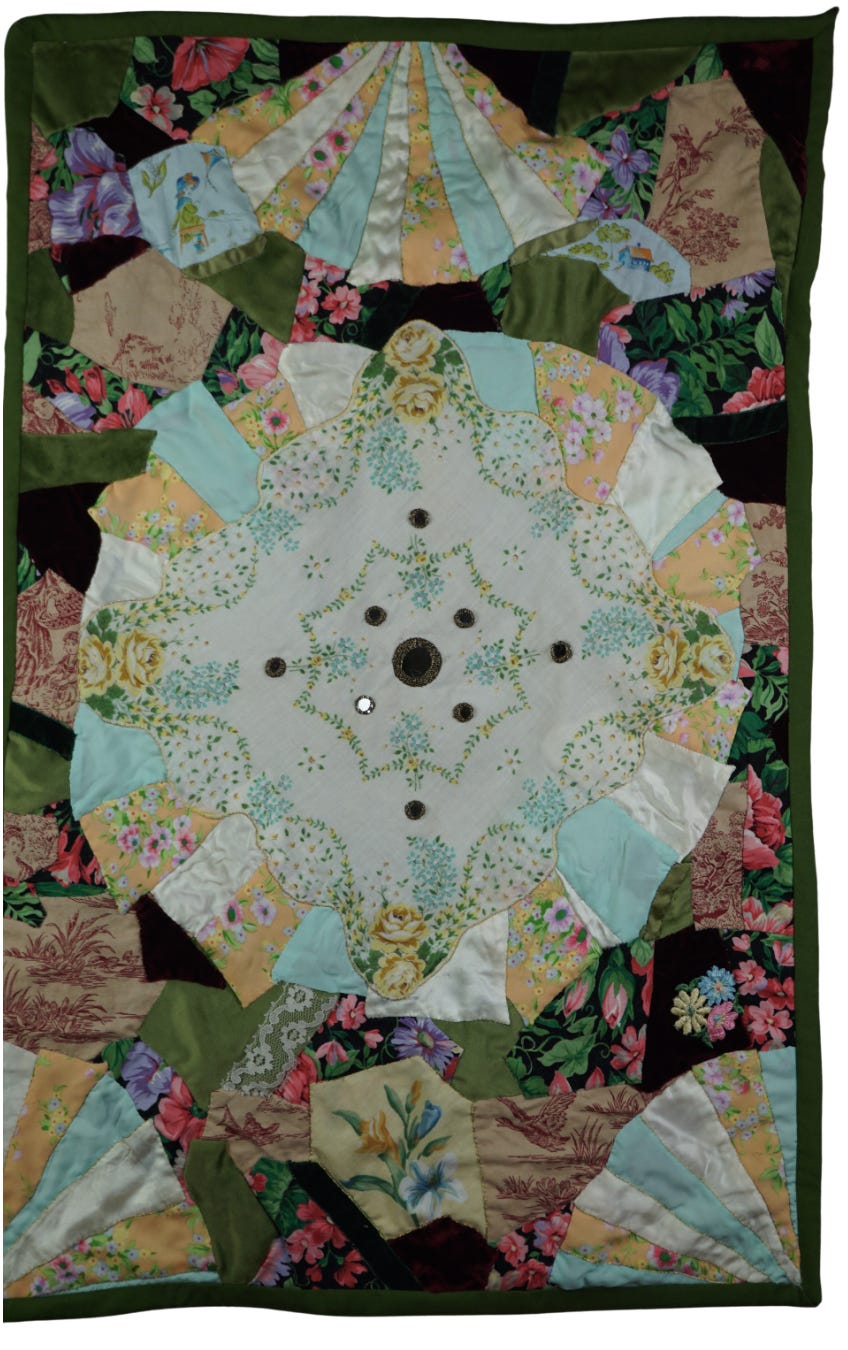
Last week I finished binding this quilt I’ve been hand stitching over the past year, and delivered it to its new owner. I’d always wanted to make a crazy quilt , and indeed, I had a bout of craziness while making it.
Each individual scrap had to be turned under to protect fraying edges from unraveling. The central medallion is the owner’s grandmother’s handkerchief, so there was an added pressure of preserving someone else’s family heirloom. Using a shisha embroidery technique to attach the mirrors to the center, I realized while applying them that there was no turning back. The delicate handkerchief beneath was permanently altered as I stitched.
For much of this process I was convinced it was hideous, and I would hide it away in the bottom drawer of my nightstand between sessions until I could face it again. Every time I looked at it there was a new imperfection to fixate on; a new fraying edge to turn under..
This quilt started with dozens of tiny pins my thread would snag and tangle against. This is what I was stitching on while writing my scrap drawer letters all throughout 2025. Both of these projects were a practice in patience, endurance, and trusting my intuition. As I collected, cut, and arranged my pieces, I did not know how they would fit together, or what my labor would amount to in the end.
I couldn’t understand my own work until I took a step back to see the whole. Stepping back from last year, I can see that span of time as a psychic training period. I was learning to search for patterns.
Collecting my scraps each month for my scrap drawer letters, I learned to gently observe the business of my mind.
As a craftsman in training, I learned it is always best to keep my mind in pace with my hands. I saw clearly how deceitful the mind is, if you let it outpace what your hands can do.
Living in a time of automation, I am blessed to have a needle and thread and some scraps to sew. I need little else, other than shelter, food, and company.
I do not wish for an automated life. I want to submit to the reality of finite time.
Over this year of hand stitching, I have eased into this idea of my bodily limitations. There is a limit to what my hands can do. I spent entire days stitching until my hands began to cramp. And one day, if I am so lucky, my hands will become arthritic and incapable of making these tiny, invisible stitches.
Until then I will continue my work, slowing my thoughts to the pace of my stitches.
What I’m Stitching and Reading!
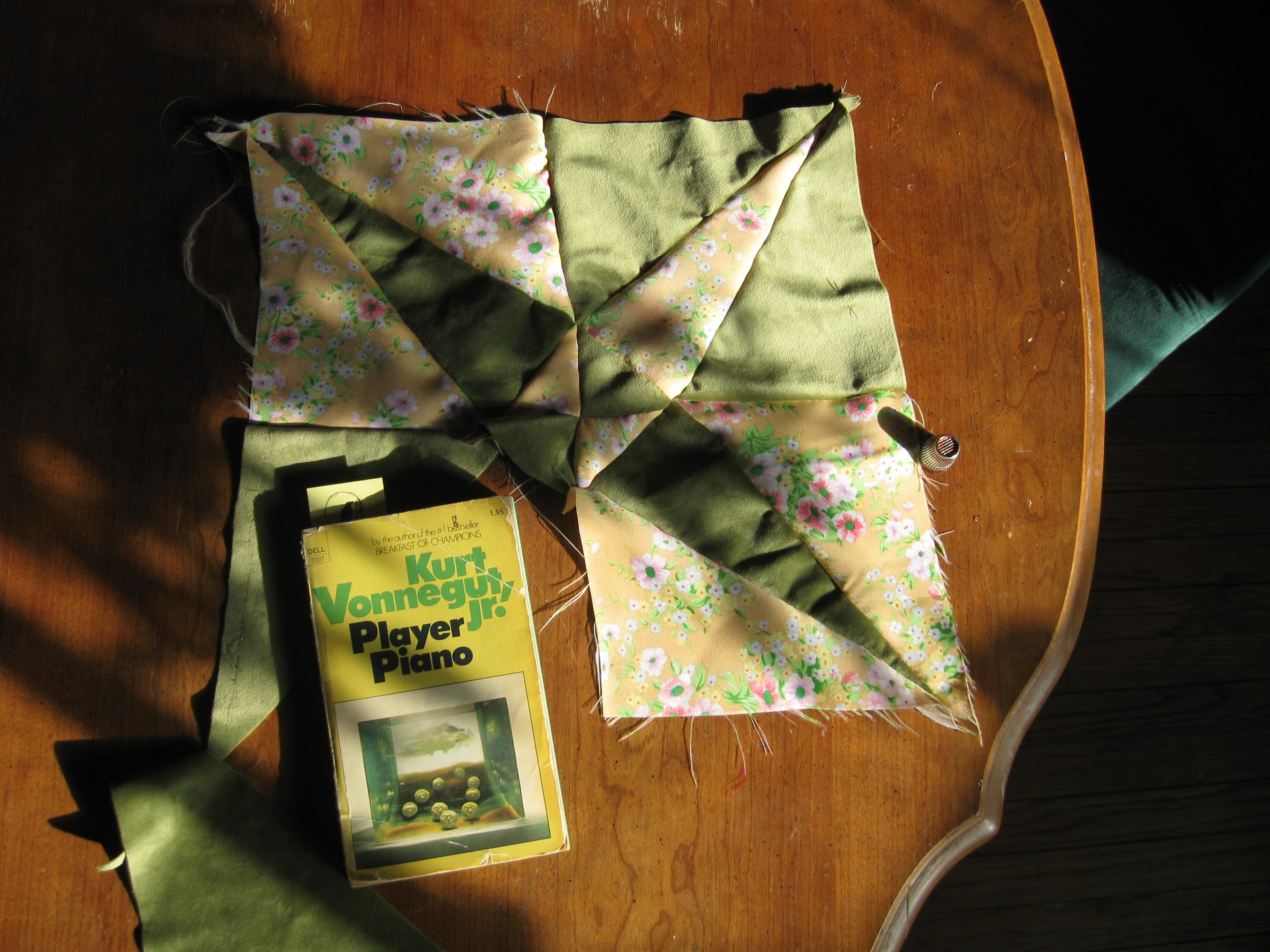
A few years back my friend Leah gave me an old book of quilt block patterns.
I took it out recently and made a template from the pattern in the book, and tried my hand at hand piecing. I love that I can make a quilt without being tied down to a machine, no matter how slow the process is.
I’ve undone my work several times, sewing the wrong edges together. The block I chose is probably out of my skill range, and the fabrics I chose are difficult, but I love a challenge.
Meanwhile I picked up Vonnegut’s “Player Piano” off of our bookshelf. This is my first time reading him, and this book seems to tie together some threads I’ve been pulling at in my own work.
Player Piano was published in 1952. It is a speculative fiction, where the world undergoes a second industrial revolution, leaving production in the United States nearly completely automated by machines.
In this universe, the IQ of every citizen is public record. Perforated cards with the results of aptitude tests rigidly define the roles of each person. The only roles that provide upward mobility are in management and engeneering. Everyone else is either in the military or what Vonnegut calls the “reeks and the wrecks”— people who fill potholes and attend to the country’s crumbling infrastructure.
If you don’t know, my day job is in adult education. I work among those in the reeks and the wrecks. I am myself one of them. The world we live in is not too far off from the one Vonnegut imagined in Player Piano.
There is indeed a strictly enforced, structural definition of human intelligence—one that is limited to those with an aptitude for logistics and management. Left to their own devices, engineering and management are cancerous. There is such a deep need for artisans and craftspeople, musicians, writers, and the like. These are the people that restore meaning to the world.
Dr. Paul Proteus, the protogagonist of the novel, is an upper echelon manager of illium works who is challenged in his role by an existential crisis.
Seperated for most of all of his life from the folks in the “reeks and wrecks,” he begins to mingle with them in a bar booth. He meets the downtrodden artists and thinks to himself:
“Sooner or later someone’s going to catch the imagination of these people with some new magic. At the bottom of it will be a promise of regaining the feeling of participation, the feeling of being needed on earth—hell, dignity….”
Through people I know through my work, and within myself, I know this longing for participation intimately. I have desired, in this newsletter, to catch the attention of others with a new kind of magic.
I don’t know where I’m going with this, but I know it has something to do with sewing.
Math in Stitches
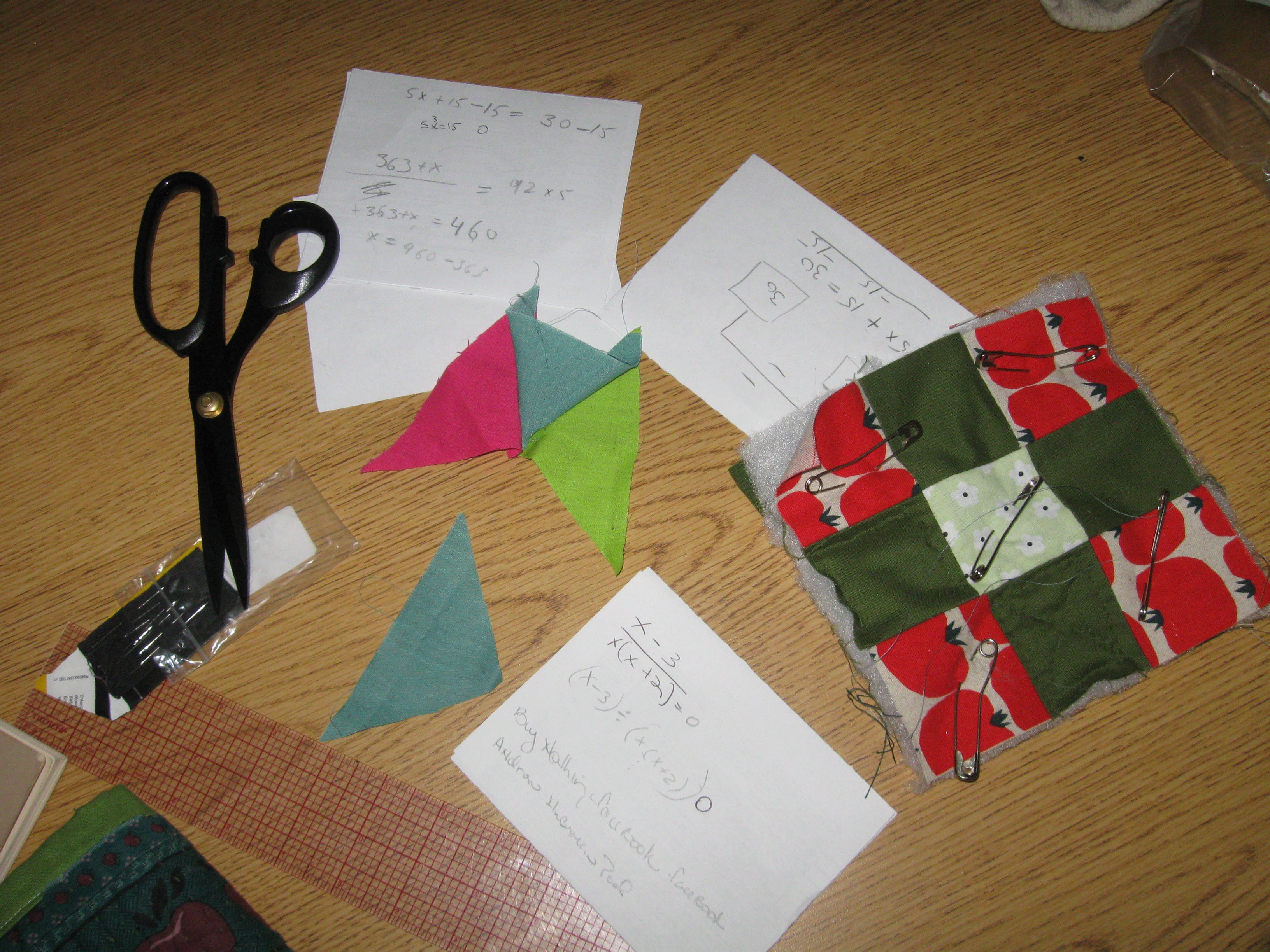
Over the past several months I’ve been working with one of my volunteer tutors to merge my sewing know-how with her math skills.
We’ve taken on one learner who is working towards getting her GED late in life. We all feel it is important for her to meet this benchmark so that she can meet other goals and move through the system. But Sewing is offering something a little more than that: a connection to a shared history.
Half the class is traditional math tutoring. While winding down from the session, we stitch. We talk about sewing and look at quilts from across the centuries from archives online.
We’re still piloting the program, and figuring out how these things work together, but I suspect I’m on to something. Quilts are proof that mathematics are a part of nature. It’s something like bees working together in a hive. They are evidence that the people who made them—largely women outside of traditional education systems—understood mathmatical concepts like proportion, area, ratios, and extremely complex geometry.
I’m looking forward to merging my private work this year with my professional work in adult education. I’m starting to see that this Patchwork Principle project has been more than just a newsletter, but an exploration of my own personal definition of literacy, and how this very private and personal endeavor has brought me back into the world from a long period of time when I was not so sure I was needed on earth.
If you’re interested in hearing about my work in adult education, I’m planning to start posting more at my other newsletter, Watch Your Knows Grow.


…quilt looks awesome, and good luck on this new educational adventure!!!…
As always, I enjoyed reading your words and felt many moments of recognition and kinship. Thank you for sharing your self with the world❤️